
- What we do for you
- About Us
About Us
- Why Choose Us
Why Choose Us
In-house Equipment
Other Important Topics
- Resources
Resources
Blog & Social Media
- Contact Us
- What we do for you
- About Us
About Us
- Why Choose Us
Why Choose Us
In-house Equipment
Other Important Topics
- Resources
Resources
Blog & Social Media
- Contact Us
Health Monitoring Smartwatch
Turning a dense health sensor PCB into a slimmer, production ready wearable through structural optimization, assembly engineering, waterproofing, testing, and PVT support.
Helping a customer refine the casing, assembly process, waterproofing, tactile controls, display integration, electrode material, and functional testing for a compact consumer health-monitoring smartwatch.
A compact wearable with many sensors and very little room for error
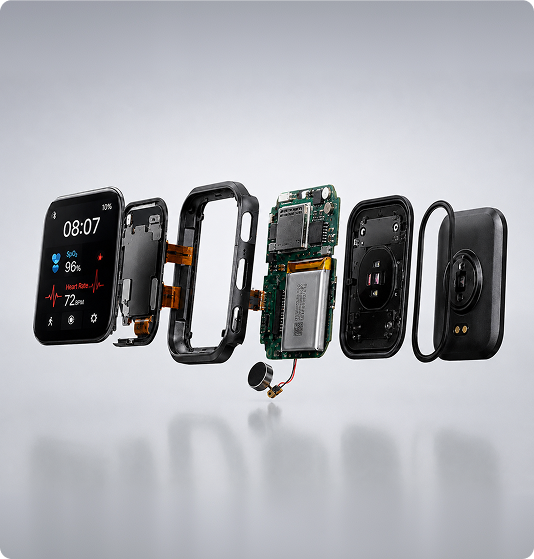
The starting point was challenging: the PCB was larger than what is usually found in compact smartwatches because it carried many sensors, while the customer wanted a smaller, slimmer, less bulky device. Agilian had to redesign and refine the mechanical structure around fixed electronics, while still protecting display performance, button feel, waterproofing, skin contact electrodes, and production test reliability.
PRODUCT type
Main user benefit
CORE CHALLENGE
Agilian scope
Industrial design direction, casing and structure optimization, assembly, testing, shipment support, PVT production support, and process validation.
The product had to become slimmer, waterproof, testable, and reliable without changing the core PCB
This smartwatch was not only a styling or enclosure project. It required Agilian to fit a dense customer-designed electronics platform into a smaller, more consumer-oriented case and make the product practical to assemble, seal, test, and ship. Several constraints were linked: reducing thickness affected the buttons, display, adhesive, FPC cable, gasket strategy, electrode contact, and final test process.
Large PCB inside a smaller case
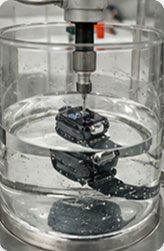
Waterproofing and button feel
LCD and FPC assembly risk
Adhesive overflow and cosmetic control
Sensor and electrode performance
Incomplete production test standards
Customer supplied firmware and tools still needed clearer reference curves, pass fail criteria, and a repeatable test protocol.
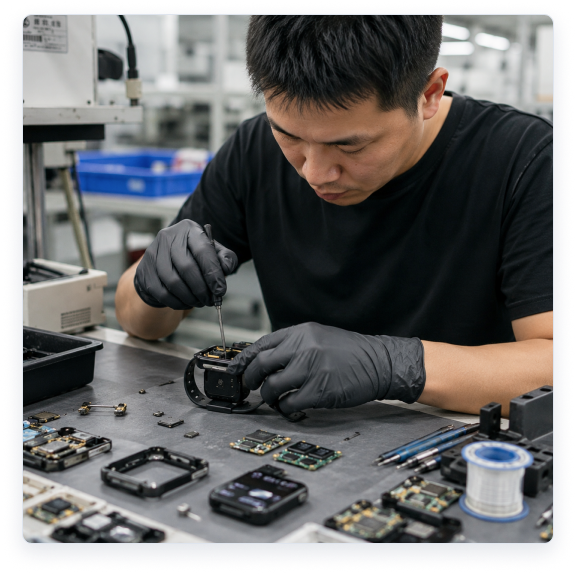
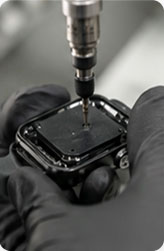
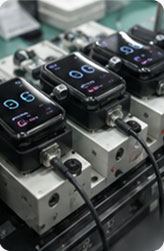
From customer electronics to a manufacturable wearable enclosure and process
Key areas where Agilian added value
The main complexity came from dense electronics, tight internal packaging, waterproof controls, display integration, sensing reliability, and production test discipline.
Casing optimization for a dense PCB
The product needed a more compact and consumer-oriented shape, but the existing PCB carried many sensors and could not simply be resized. The casing had to be adjusted around the electronics rather than the other way around.
Waterproof button structure
Display and FPC protection
The internal stack pushed the LCD upward and left little room for the display FPC. Agilian had to develop an assembly process that protected the FPC and reduced the risk of screen damage.
Adhesive and cosmetic control
Glue overflow could damage the appearance, while insufficient adhesion could let the LCD or back cover move over time. The team tested adhesive options and considered performance under heat and humidity.
Skin-contact electrode material
The ECG electrode had to be safe for skin contact while also giving good electrical conductivity. The material was changed to 316L stainless steel to support both needs.
Testing protocol and operator variability
ECG and PPG signals varied by operator and test conditions. The team learned that the tester must remain relaxed and still, and that reference standards and test methods need to be defined as early as possible.
Wearable products leave almost no tolerance for late assembly surprises
The main lesson from this product is that a wearable product cannot be treated as a box around electronics. The PCB, battery, display, electrodes, buttons, adhesive, waterproofing strategy, vibration motor, and optical windows all compete for the same very small internal space.
When the product was pushed toward a thinner and more consumer-oriented form, small design choices had large production consequences. A button with the wrong stroke could feel inconsistent. A display FPC folded too tightly could fail. A gap around the back cover could expose glue and damage the appearance. A poorly defined ECG/PPG test could consume excessive line time and still produce inconsistent results.
For similar projects, Agilian would push earlier for complete PRD confirmation, supplier input on materials and light-transmission behavior, assembly feasibility review at the sample stage, and a documented test protocol with clear pass/fail criteria before trial production.
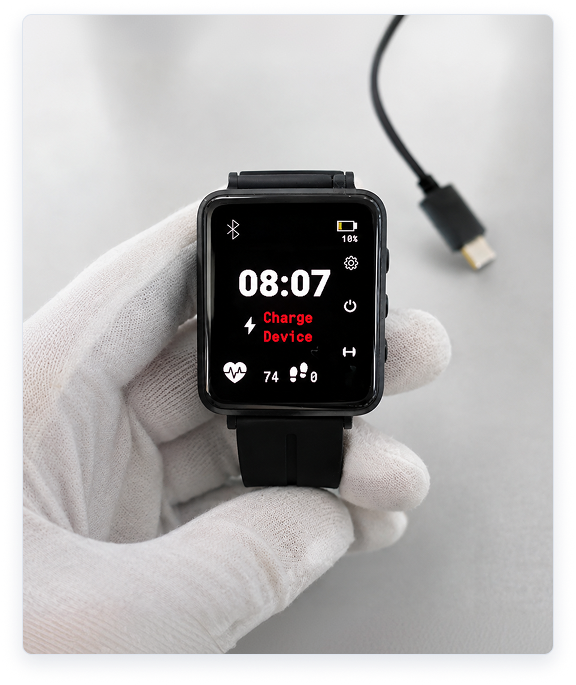

On a smartwatch project, the casing is not just cosmetic. Every tenth of a millimeter affects waterproofing, button feel, display assembly, electrode contact, and test reliability.
Before vs After
A clear comparison showing the move from a sensor-rich customer electronics platform to a more controlled and production-ready wearable product.
Before
- Customer-owned hardware, software, app, and test tools, with limited design documentation available to Agilian.
- Large PCB and many sensors inside a case that needed to become slimmer and more consumer-oriented.
- Waterproofing and button feel not yet stable enough for consistent production.
- LCD/FPC and back-cover glue process creating yield and cosmetic risks.
- ECG/PPG signals difficult to standardize and heavily affected by operator and test conditions.
- Manual “try it on the hand” testing expectations without a structured production protocol.
After
- Casing and structure refined around the fixed electronics and tighter internal stack.
- Side-button tactile feel improved using a silicone keypad post and further sealing work.
- Adhesive system selected to improve sealing, reduce whitening, and allow cleaner overflow removal.
- Assembly process refined to protect display FPC and manage LCD/back-cover retention.
- Electrode material changed to 316L stainless steel for skin contact and conductivity needs.
- More structured checks and pass/fail validation defined for shipment readiness.
A more manufacturable smartwatch with clearer production risks and controls
This project reached the engineering PP / PVT stage with a clearer understanding of what had to be controlled before shipment: structure, sealing, adhesive behavior, display protection, electrode contact, light masking, operator-dependent ECG/PPG testing, and customer-defined pass/fail standards. The value of the project was not only in modifying parts, but in turning an informal engineering prototype into a more structured production and validation process.
Compact design direction created
Agilian helped make the product less bulky and more consumer-oriented while accommodating a dense, sensor-rich PCB.
Waterproofing and button issues clarified
The team identified the tradeoff between thin buttons, tactile feel, silicone keypad structure, waterproofing, and assembly consistency.
Display assembly risk reduced
Assembly details were developed to protect the LCD FPC and reduce damage risk during screen installation.
Adhesive process improved
The team tested glue systems and selected an adhesive better suited to sealing, cosmetic control, curing behavior, and cleaning after overflow.
Electrode and sensing risks addressed
Electrode material, ECG/PPG signal quality, operator variation, and PCBA/contact checks became visible production-control points.
Testing discipline reinforced
The project highlighted the need for clear PRD requirements, reference standards, test protocols, and pass/fail criteria before trial production.
Building a wearable product with dense electronics and tight assembly constraints?
Tell us what you are building, where the risks are, and what you need to validate before committing to production.


Agilian (Dongguan Agilian Technologies Co., Ltd.) is certified to ISO 9001:2015 (FM 763143) and ISO 14001:2015 (EMS 774980).
Quick Links
Contact
Agilian Technology Co. Ltd.
Unit 203, 2nd Floor, Haorong Zhichuang Science & Technology Building,
No. 47 East 1st Street, Xingfa South Road,
Wusha Community, Chang'an Town,
Dongguan, Guangdong, China 523859
Phone (CN): +86 133 4263 0352
Email: inquiries@agiliantech.com
Opening hours (China time):
Mon–Fri: 08:30–18:00
Sat: 08:30–13:00
Sun: Closed
We respond to all inquiries within 24 hours.

