
Agilian

Portable
Scent Diffuser

Turning a compact scent product into a manufacturable, battery-powered consumer device with controlled heating, low-odor materials, and production-ready details.

> Case Studies > Portable Scent Diffuser

Developing a compact portable scent diffuser for natural scent delivery

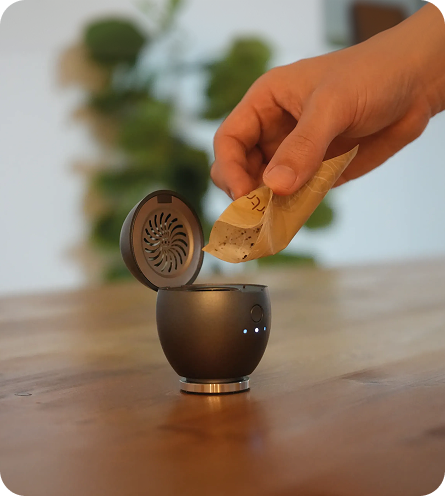
This innovative product was developed around a simple idea: create a small, portable diffuser that could deliver a natural scent experience without water, essential oil mist, or residue.

Client type

Consumer product team developing a portable scent device for everyday environments.

Main challenge

Create a compact heated electronic product while managing thermal, material, odor, battery, or reliability risks.

Timeline

A working, near-final device was achieved in roughly three months, before tooling and production refinement began.

Agilian scope

Industrial design, mechanical design, electronics, software, prototyping, tooling, pre-production, and mass production support.

Portable Scent Diffuser

Multiple constraints inside a small heated consumer device

The portable scent diffuser looked simple from the outside, but the product needed to combine heat, battery power, electronics, plastics, software, scent performance, and a premium user experience in one compact assembly.

01

Controlled
heat transfer

The heater had to warm the scent material consistently without overheating the battery, PCBA, or surrounding plastic parts.

02

Battery
Integration

Portability required an internal battery, but batteries add thermal risk, packaging constraints, cost, and long-term reliability considerations.
03

Low-odor material
selection

Some heat-resistant plastics can withstand high temperatures yet still emit odor; for a scent product, that would undermine the user experience.

04

Surface finish
durability

The original painted finish risked cracking, peeling, or aging under long-term heating, so the finish strategy needed to change.

05

Lid and
hinge feel

The lid, opening friction, alignment, and closing feel all mattered because users handle this part every time they load scent material.

06

Charging
indicator logic

Production testing showed that the full-charge voltage threshold had to be adjusted so the indicator reflected real battery behavior.

Portable Scent Diffuser development cycle

From concept to production in a compressed development cycle

The early market opportunity was already visible, so Agilian had to move quickly while still validating the engineering risks that could affect production later.

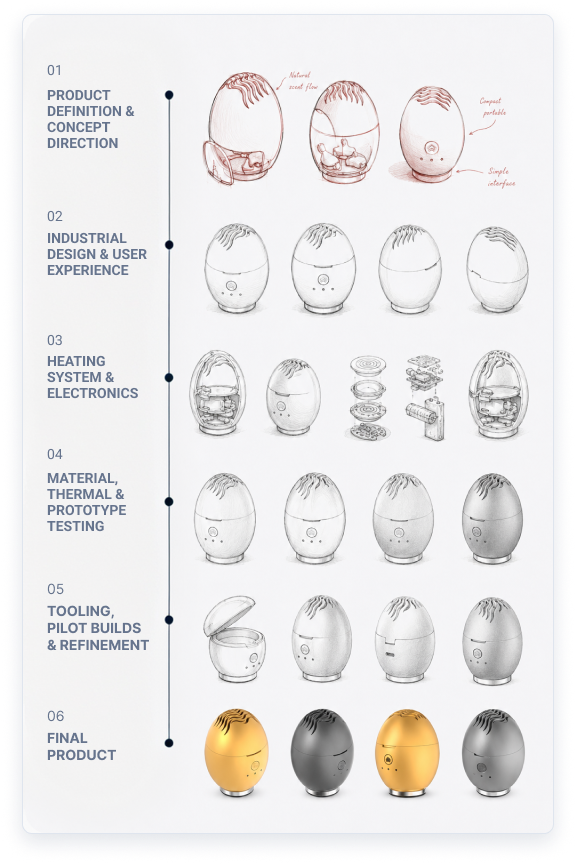
The project was managed as a full new product development program, not just a sourcing or assembly task. Industrial design, mechanical engineering, electronics, software, prototyping, tooling, and production preparation were kept connected.

1
Product definition and concept direction
Define a portable diffuser for natural scent materials,
suitable for use at home, at a desk, in a car, in a hotel, or while traveling.
2
Industrial design and user experience
Develop a rounded, egg-like form that felt distinctive,
compact, and suitable for different everyday settings.
3
Heating system and electronics
Build the product around a ceramic heating solution, metal heating
assembly, battery, PCBA, USB charging, and operating logic.
4
Material, thermal, and prototype testing
Test heat resistance, odor behavior, surface finish aging,
internal temperature, and practical handling & usability.
5
Tooling, pilot builds, and refinement
Move into tooling and pre-production, then refine lid alignment,
hinge feel, heat flow, and charging thresholds.

Key areas where Agilian's development effort mattered most

The product’s main complexity came from combining thermal performance, battery power, plastics, electronics, and tactile experience in a small consumer device.

01

Thermal management

Improve internal heat flow so the scent material could be warmed effectively while protecting the battery, PCBA, and housing.

02

Material choice

Test materials for heat resistance and odor emissions, then select heat-resistant, low-odor polycarbonate (PC) for key plastic parts.

03

Finish optimization

Move away from painting and toward sandblasting to reduce long-term heat-aging risks such as cracking, peeling, or finish degradation.
04

Battery and PCBA integration

Package the battery, PCBA, charging interface, heater control, and operating modes inside a compact enclosure.
05

Hinge and lid feel

Refine opening resistance, closing feel, alignment, and hinge details because the lid was a repeated user touchpoint.
06

Software and charging behavior

Adjust voltage sampling thresholds after production testing showed the full-charge indicator needed to reflect real unit behavior.

Turning a compact product idea into a manufacturable heated electronic device

The goal was not simply to make a nice-looking diffuser prototype. Agilian had to turn a compact product idea into a device that could be tooled, assembled, tested, charged, handled, and used repeatedly in real conditions.

That meant making practical decisions about heat paths, battery placement, enclosure material, surface finish, hinge resistance, charging logic, and assembly details before production.
The result was a product architecture designed to work as a consumer device, not just as a one-off concept sample.
Portable Scent Diffuser prototypes

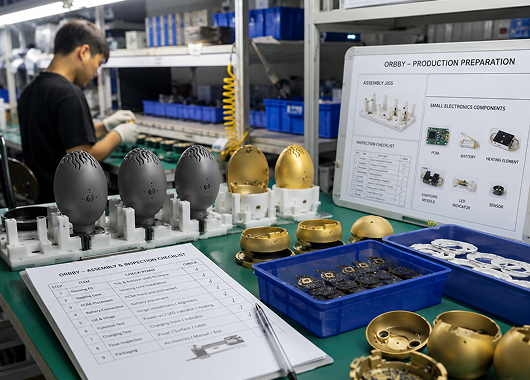
Production preparation included assembly jigs, an inspection checklist, and testing of small electronic components.

Agilian’s Testimonials

A portable scent diffuser taken from concept to production

Agilian developed the diffuser through the full NPD path, resolving key engineering problems around heating, material behavior, battery integration, surface finish, tactile details, and compact assembly.

Full NPD completed

Design, prototyping, electronics, software, tooling, pre-production, and production support handled under one development path.

Fast development cycle

A working, near-final device was achieved quickly before tooling and production refinement.

Thermal risks addressed

Heat transfer, internal temperature, airflow, and material performance were improved through engineering validation.

Material risks reduced

Low-odor, heat-resistant plastic choices helped protect the scent experience and product reliability.

Production details refined

Hinge feel, charging thresholds, finish durability, and assembly details were improved during pre-production and launch.

Reusable engineering knowledge

The project strengthened Agilian’s ability to develop compact consumer products combining heat, batteries, plastics, electronics, and sensory user experiences.

Before vs After

A clear comparison showing the shift from an early product idea to a production-ready portable scent device.

Before

After

Developing a compact electronic product with hidden technical risks?

Agilian helps teams turn product ideas into manufacturable products by connecting design, engineering, prototyping, tooling, testing, and production under one roof.