
To keep it simple, every hardware startup faces three types of pitfalls: market, technical, and funding challenges. In part 1 of this 3-post series, we covered how to follow a systematic “customer development” process. In part 2, we mentioned the need for a systematic “new product introduction” approach. Now, in this third part of our series, we’ll focus on how not to run out of cash.
For hardware startups that need to incur product design costs, upfront tooling investments, high minimum order quantities (MOQs) for some expensive components, and other cash outlays, a solid funding strategy is essential.
Developing a Solid Funding Strategy
A clear, well-thought-out funding plan should address the following:
- Self-funding – How much can you cover yourself in the early stages?
- Friends and family – Are there opportunities to secure early support from personal networks?
- Debt financing – Often a must for getting a hardware startup off the ground.
- Angel investors and venture capital – What level of funding will you need from professional investors?
- Crowdfunding – Could you raise funds this way? Keep in mind that it creates delivery obligations.
- Customer pre-payment – Is there a path to secure capital from early customer commitments?
- Customer terms – Will retail channels, or big customers in general, request payment terms? How many days after delivery?
- Invoice financing from a bank based on a customer’s purchase order – Will that be an option? Some customers’ banks even arrange it for suppliers.
- Margin per unit sold – Will you be making enough margin after the total landed cost and the marketing/distribution costs to scale the sales volume up?
When manufacturing in Asia, your funding plan also needs to cover the extra working capital involved in payment for production, way before the goods land in the country of sale.
You May Not Actually Need To Talk To Investors
If you can fund the initial phases of product development, sell company shares to friends & family, borrow money, and/or pre-sell the product to customers, you may not need external funding.
That typically requires a certain discipline. Here are three approaches that have enabled entrepreneurs to release a hardware product on the market without resorting to investors:
a) The stair-step method of bootstrapping
Former entrepreneur Rob Walling coined this term and applied it to software startups. The good news is, there is a way to do it in hardware, too, and this is an approach that we often suggest to hardware startup founders.
You can start by reselling an ODM product (which does not belong to you and over which you have limited control). Many Chinese companies accept selling their products as an ODM supplier. If you provide a good idea to improve one of their products, they often agree to bear the investment to make it happen and to grant you exclusivity over a certain market.
Here is the way it often plays out:
Step 1: Resell an existing (ODM) product. Learn about the market. Establish a market channel. Learn what users tend to be frustrated about.
Step 2: Work with the supplier of the ODM product to add 1 or 2 key features and negotiate exclusivity over your market. If you have purchased volumes that the supplier sees as significant to their own business, you can usually negotiate something special. You will probably need to pay for the extra development cost, maybe for a special mold, etc., and you may have to hit certain sales performance numbers, but it is often possible.
Step 2b (sometimes makes sense): if step 2 is not possible for some reason, it may make sense to develop a product based on a pre-developed platform. This type of option is increasingly popular in Shenzhen. For example, finding the R&D company that has developed the PCB for a smart watch, finding a plastic supplier that already has a mold for the case of that smart watch, and then managing the development of the rest of the product around it. That’s cheaper and faster than step 3.
Step 3: Once you have a clear idea of what a superior product would entail and what type of target users/customers it may be suitable for, invest in developing that new product from scratch with a contract manufacturer. Do things right, including contracts. Own the product. Register some intellectual property if that makes sense. It’s a huge step up from step 2, and it is more ambitious than step 2b, but it provides much more design freedom.
A down-to-earth way to scope Step 1
We found a helpful LinkedIn post that shared a simple, no-nonsense way to answer “How much do you actually need to start?” Use it as a checklist to keep Step 1 small and survivable:
- Pre-launch essentials: samples & minor tweaks (not full tooling), basic packaging, a minimal photo/video set, and a lightweight landing/listing.
- First small batch: MOQ that you can sell through in weeks, not months; shipping & duties; basic compliance/marking where applicable.
- Go-to-market: one channel setup (listing + on-page SEO), one acquisition motion (e.g. marketplace search or a tiny paid test), and a tiny promo budget.
- Operating runway: 1–2 reorders worth of cash timing mapped against lead times; a contingency buffer so a slip doesn’t kill you.
- Pass/fail gates: “Greenlight only if” the contribution margin covers COGS + fees + minimal ad spend and shows a path to reorder without new capital.
The core message mirrors stair-stepping: constrain scope, make the math work at a micro scale, then reinvest. We’ll link that LinkedIn post here so you can see the example and budgeting approach they outline.
b) Pre-sell the product
There are ways to collect money in advance from customers:
- If you sell to established companies that issue a purchase order (PO) to you, take advantage of the possibility of getting a bank’s financing against that PO.
- If you sell on a platform such as Indiegogo or Kickstarter, you collect funds months – and maybe over a year – before you need to deliver products.
This can work well with differentiated products that address a pressing need. The more unique the product, and the more superior it is (for target users) over existing alternatives, the more certain customers will be willing to pay in advance.
We should also warn you about the unfortunate fact that most Kickstarter campaigns fail, either by not reaching their declared target, or by leading to costs (including setting up the campaign, paying advertising…) that surpass the margin it brings back. A consistent mistake we have seen is an insufficient margin on the price the product is offered on crowdfunding platforms.
c) Keep the product as simple as possible
This seems obvious, and yet many startups insist on developing what in their minds is a ‘perfect product’. You need to keep the product simple in 2 ways:
- Fewer features, focusing only on the few features that are most valuable to users/buyers, based on information gathered when doing ‘customer development’ work.
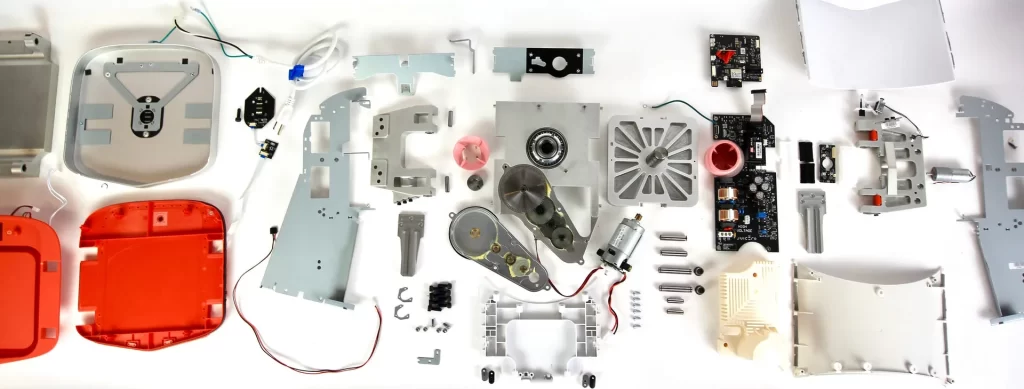
- Reusing standard off-the-shelf parts as much as possible. See the many custom components from this example of product that went the opposite direction and is way too complex:
A simpler product comes with many benefits:
- Less design & development work, lower investment in tooling, and probably lower compliance testing fees.
- A shorter time to market, which means expenses in the pre-revenue phase are lower
- A cheaper bill of materials, meaning the product can be sold at a lower price point and/or the company can make more margin.
Now, if you still need to work with investors, we will provide general advice in the rest of this article.
You may have to take on some debt
If you are in a startup hub, have good connections to potential investors, and are in an exciting space, you will probably try to raise money from investors. In other cases, if you need cash from other parties, the most likely source will be debt financing.
If you are starting your company from scratch, you will probably be requested to provide a personal guarantee, which can be stressful. Thousands of hardware entrepreneurs have done this.
It is not all about the downside. When the business goes well, being leveraged plays in your favor and you don’t give away control to investors. You have more options, such as accepting investors later on with less overall dilution of your shares.
Remember, once you have a “real company” that shows revenue and that has achieved at least break-even, there are ways to raise a loan. In the USA, many companies have been able to get an SBA loan.
Choose your Investors Wisely
You may want to Google “VC horror stories”. You will see how picking the wrong investors and giving them too much power can kill your company.
And, you like to go to the bottom of a topic, you may enjoy the book “Venture Deals: Be Smarter Than Your Lawyer and Venture Capitalist” by Brad Feld and Jason Mendelson, that book will open your eyes on how exposed you will be if you deal with experienced investors without pick a suitable lawyer who defends your interests.
One more tip, here. Make sure to work with investors whose experience is not solely in software products, as their expectations may not match the realities of hardware. They might push you to “hack something together” and “just fix it once issues appear”. However, if you skip the important validation steps we described earlier (remember the New Product Introduction approach?), your path to production will probably be quite painful.
What Investors Want to See
Let’s break the 3 main elements down:
1. Team Strength
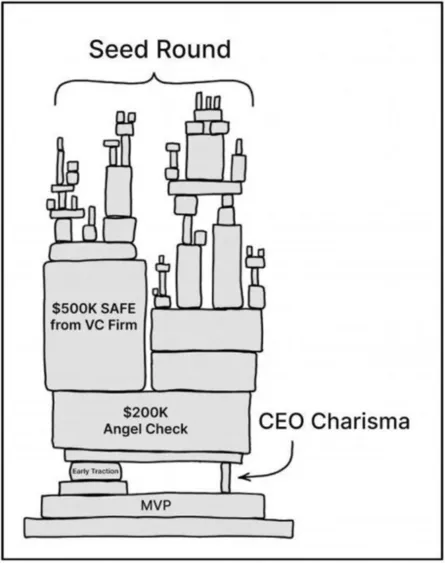
In the early days, the past experiences of the team and the ability of the CEO to sell a big vision are what matter most, as illustrated below. (Source.)
Here are important topics, from the investors’ side:
- Do the founders have the right experience?
- Have they successfully launched similar products before?
- Are they open to feedback or rigid in their approach?
- Do they understand the market and product category well?
- Does it seem that they know what to do, and they are getting good advice?
2. Product Potential
In software, teams sometimes pivot and get to work on a completely different type of product. In hardware, the startup will probably live or die based on the product they are already designing.
Here are important considerations:
- Does the product align with current investment trends? (This is like fashion – certain product categories tend to be much more attractive to VC investors.)
- Are you talking to investors whose interests match your product category?
- Does the product spark excitement in initial discussions?
- Is there a revenue stream that tends to be valued at higher multiples (e.g. recurring revenue for some software features, license revenue for access to proprietary data…) than hardware sales?
3. Market Size
If the market is non-existent or is small, a company will have difficulty growing to what professional investors aim for (at least a 100 million USD company).
Here are typical questions they ask:
- Is the market large enough to attract serious investor interest?
- Is there strong evidence of long-term growth potential?
- Has the founding team carried out some important market discovery work? (See the earlier article about getting the market right.)
- Is there evidence of market traction?
You need to be ready to present those 3 elements of your startup in a positive light if you want a chance at getting investors interested. Venture capitalist Jeff Clavier sums it up as his “three asses” rule: he’s looking for “a smart-ass team building a kick-ass product in a big-ass market”.
What Investors Don’t Like to See
Many investors detect risk when they see certain ‘amber flags’, and they tend to give excessive weight to those signals. Here are a few typical examples:
- “Inactive founders who still hold many shares” – many startups end up with a bad capitalization table early on because of inactive founders who were given shares without the usual provisions of a good shareholder agreement.
- “A lot of debt” or “poor reputation”. Some hardware startups have managed to acquire both because of a crowdfunding campaign that was done with a price that is too low to pay for the factory price of making the product. The company delays the launch, starts to sell in other channels in order to get some margin and stay alive, gets bad press, and still owes all those products to the backers – it is effectively a debt!
- “Manufacturing will be in China” – that has become scarier and scarier to USA-based investors. Does it make sense in the long term? Time will tell.
- “This seems easy for Chinese factories to copy” – that is a real concern for certain types of products. See two examples we saw first-hand in ‘How Chinese Knockoffs Are Killing Innovative Hardware Startups.‘ The right approach is usually to avoid creating a lot of buzz on the internet and to sell the product in channels where sales numbers cannot be estimated, as an effort to avoid attracting attention in China. On the other hand, certain products are very challenging to manufacture and cannot really be simplified, and they are in a better position, see this amazing keyboard, for instance.
Building a Credible Business Plan
A well-prepared business plan should detail your capital needs from design to production scale-up. Include key non-recurring engineering (NRE) costs like:
- Design fees, prototype materials, and testing
- Mold Tooling costs – Fabrication, adjustments, and setup
- Compliance and reliability testing costs
- Travel expenses – Factory visits, supply chain meetings
You should also plan for your unit economics – estimated factory cost, landed cost, and target margins.
Many hardware startups find out way too late that their COGS (Costs Of Goods Sold) are too high and will force them to sell the product at a higher price, leading to a lengthy redesign. Some actually go to production anyway because of the pressure of deadlines, but they don’t have the margin for marketing & distribution or for scaling up. (See ‘The 3 Major Hardware Startup Killers: Part 1 – The Market‘ where we discuss the importance of knowing what features are critical and which ones can be dropped if necessary.)
A clear business plan gives investors the ability to check & confirm that you’ve accounted for realistic costs of hardware development as well as marketing & distribution.
Managing Funding Execution Risk
Marc Andreessen warns that poor execution of a financing strategy sinks many startups and stresses the need for prudent financial strategies and disciplined execution in this series of tweets. In his eBook: The Pmarca Guide to Startups: Part 2, When the VCs Say No, he says that hardware startups who have already received knock-backs from VC should also:
“Rethink very carefully how much money you will need to raise after this round of financing and try to change the plan in plausible ways to require less money.”
Being financially prudent and organized is especially true for a new hardware product:
- Set realistic fundraising timelines – Expect delays in investor decisions.
- Raise more than you think you need – Hardware development almost always costs more and takes longer than expected.
- Start early – Begin raising the next round while you still have at least six months of runway.
- Have a backup plan – If your primary strategy falls through, know where to turn next.
- Watch the market – Broader economic conditions can affect investor appetite.
Be specific about your production ramp-up plan. Common mistakes include:
- Rushing pre-production validation, leading to quality problems
- Planning to scale production up faster than available cash flow will allow
Since manufacturers rarely offer credit terms to startups, be prepared to cover deposits and balances on time.
Strategic Funding Milestones
A staged funding approach helps align capital with development progress. It often looks this way:
- Self-fund until you have a functional prototype (it doesn’t need to look perfect yet). If you don’t have a prototype yet, most investors will turn you away.
- Secure engineering prototype funding once you’ve demonstrated both form and function.
- Raise production funding after you’ve validated tooling and production processes. (Only do this if you couldn’t raise enough in step 2 to also get you through step 3… ideally, you could raise enough.).
The ideal situation is to raise enough capital to cover product development, manufacturing transfer, and initial production ramp-up until unit margins can support ongoing production. This is confirmed by three young entrepreneurs interviewed by Forbes, one of whom actually warns against raising too much funding:
“When designing the amount of money you want to raise, try to think 18 months or 2 years,” he said. “More, and it will explode your financial bladder, and you will use the money too fast.”
This bears repeating. If you raise money during or at the end of product development, raise more than you think you will need. In most cases, startups underestimate the likelihood and the impact of unpleasant surprises. Being stuck at the phase where the company has done all the work to be ready to go into production, but has no cash for it, is very uncomfortable. There is no momentum to get investors excited. For founders, this is extremely frustrating.
A couple of common funding pitfalls we have seen too often
- The startup does not raise enough money to go all the way from prototype to mass production (including the production and marketing/selling costs), and then they find that all investors ask for evidence of fast & easy sales before they fund production.
- The startup needs an amount that is too large for most angels but too low for a traditional VC firm, and that makes raising money much more complicated than it should.
Accounting for Delays (Because They Will Happen)
Hardware development rarely goes perfectly, especially when manufacturing overseas. Build financial buffers for:
- Certification delays
- Tooling revisions
- Supplier issues
- Component failures
- Testing and validation bottlenecks
Conclusion
By carefully planning your funding strategy, setting realistic timelines, and preparing for the challenges of hardware manufacturing in Asia, you’ll create a more resilient foundation for your startup. Underfunding usually means the company fails, sometimes after years of hard work.