
If you’re building a hardware product, let’s go through the V1.0 product to V2.0 roadmap and why your version 1.0 product is not your “cheap test.” It’s your credibility. In our previous article on what makes a great version 1.0 product (and why it’s not an MVP), we explained why hardware teams should aim for a focused, ‘simple lovable & complete’ release, not a half-finished test. This post picks up where that leaves off: what to do next…
The short version: a strong v1.0 is focused, manufacturable, and genuinely valuable to some customers, not a rough draft you hope they forgive.
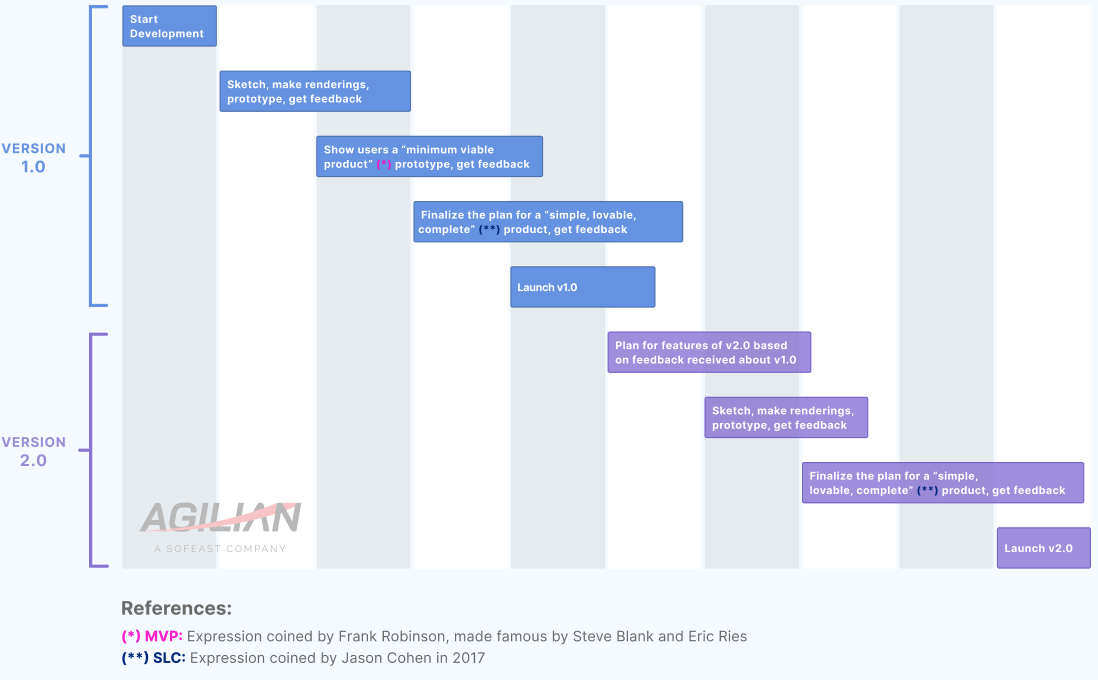
That graphic tells the bigger story: what comes next. The real advantage of a well-executed v1.0 is that it creates the cleanest possible learning cycle for a confident v2.0.
Product v1.0 vs MVP: why the distinction matters in hardware
In consumer software, “ship fast and patch later” is often seen as a viable default. In hardware, it can be fatal. When teams blur product v1.0 vs MVP, they often end up doing one of two things:
- They underbuild: shipping something too fragile, too confusing, or too incomplete to earn trust.
- They overbuild: stuffing in features early that inflate risk, cost, and timeline.
Either way, the result is the same: wasted time and a shaky grasp on the market.
A better goal for v1.0 is “simple, lovable, complete.”
“Complete” doesn’t mean feature-rich. It means the user journey works end-to-end. The type of customers who are a good fit for this version can buy it, use it, and feel the product delivers on its promise without disclaimers.
An extreme example would be a product that targets:
- Hobbyists with the v1.0
- Then, a more general market comprised of innovators who like to ‘tweak the dials’ by themselves in v2.0
- Later, a much wider market that consists in good part of people who usually resist taking risks and buying a new type of product
The hidden superpower of a strong version 1.0 product
A great v1.0 acts like a filter. Because the scope is tight, your feedback is clearer. Your support data is cleaner. Your manufacturing issues are easier to isolate.
This is where a successful V1.0 product to V2.0 roadmap really begins, not with brainstorming sessions, but with real-world signals such as:
- Which use cases customers repeat most.
- What customers tend to love, and what they tend to complain about.
- When it comes to complaints, study the data about returns.
- The features people expected vs the ones they actually value.
- Which variations sell, or not.
All of this is great learning. And, of course, you should be making a sufficient margin on the product in every version, so that it can help fund the development & industrialization of the following version.
Turning v1.0 learning into a v2.0 plan
The graphic above shows a deliberate sequence: plan the v2.0 features based on v1.0 feedback, then return to sketching, prototyping, and validation. This is where many teams go wrong.
Instead of a disciplined roadmap, v2.0 becomes a wish list. That’s how feature creep sneaks in: quietly expanding BOM cost, adding tooling changes, and complicating testing, certification, and quality control.
A strong v2.0 plan does three things:
- Prioritizes by impact
Focus on improvements that meaningfully change customer outcomes, not just add novelty. Some extra functions on a smart product are good if they bring value. More qualitative materials are preferable if people are happy to pay a higher price for them. And so on.
- Maps every feature to manufacturing reality
Every new function has Design For Manufacturing implications. Ask early: “What does this do to assembly steps, yield, reliability, tooling, and supplier complexity?” Strong DFM thinking protects both margin and schedule.
- Keeps the same disciplined build loop
Move from prototype to production with a structured NPI process, clear validation gates, controlled changes, and tight cross-functional alignment.
Why is this approach faster?
Narrowing your scope will tend to accelerate things. A well-defined v2.0, built on validated v1.0 learnings, avoids ‘feature bloat’ as well as expensive late-stage pivots.
For Agilian customers, this is the difference between:
- A v2.0 that slips because it tries to be “the definitive version,”
OR - A v2.0 that launches decisively because it’s a focused upgrade of something the market already trusts.
The takeaway
A powerful version 1.0 product isn’t the end of the journey: it’s the foundation of your next win. Build v1.0 to be “simple, lovable, complete,” treat data from customers’ hands as your main source of information, and shape a V1.0 product to V2.0 roadmap that resists feature creep and respects the realities of DFM and the NPI process.
That’s how hardware teams create product lines that scale, without burning time, cash, or reputation.