
Startup Killer 1 – Market Misjudgment & Mispreparation
Launching a hardware startup is building a three-legged stool: you need to get product, market, and funding right. If any leg is too weak, your venture will probably collapse!
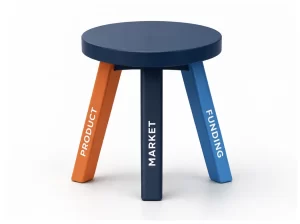
This three-part series explores each major category of hardware startup killers, starting with the most common market-related mistakes.
Comparing Technology Readiness Level (TRL) VS Commercial Readiness Level (CRL)
A helpful way to visualize why this “three-legged stool” can fail is to compare Technology Readiness Level (TRL) with Commercial Readiness Level (CRL). When TRL advances far ahead of CRL, teams can end up with a technically impressive product that doesn’t yet have proof of demand, willingness to pay, or a credible path to revenue. That imbalance is one of the most common hidden patterns behind market-related failure.
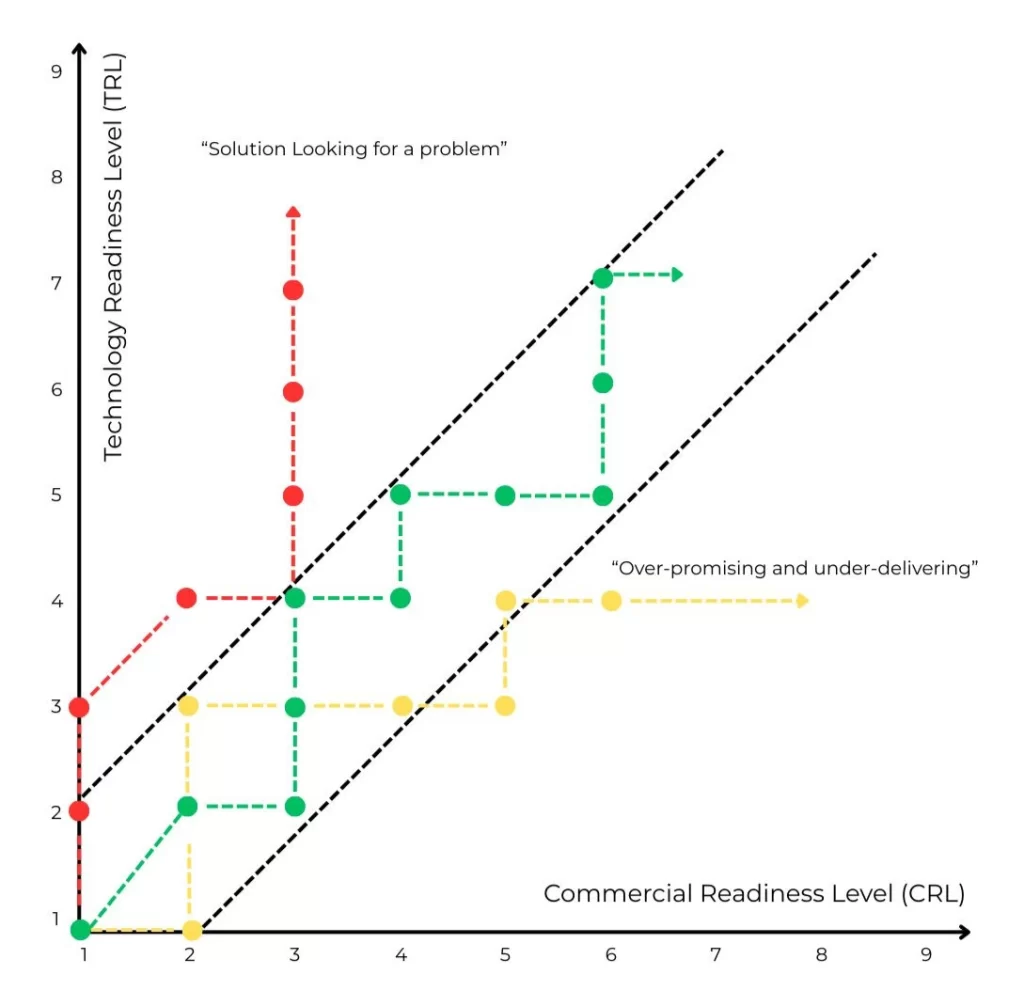
(Graphic: TRL vs. CRL gap as a warning sign for deeptech/hardware commercialization. Credit: Magnus Ahlstedt (used with attribution).
Understanding your target market and developing something they want before committing to large investments is essential. We suggest some tips and a methodology to achieve those objectives.
Very Early Stage – Identifying Your Target Market
Before finalizing your product concept, you need to plan ahead and identify what important information you are missing.
Here are some critical questions to ask yourself:
- Is there a defined group of potential customers seeking solutions to problems your product addresses?
Is it a sizeable market or a niche opportunity?
Is it a vertical market (easier to identify) or horizontal (requiring broader strategy)?
How urgent is the need for your solution—is it an “aspirin” (must-have-now) or a “vitamin” (nice-to-have)?
Do potential customers communicate with each other about their challenges?
What sales channels work effectively in this market?
What’s the competitive landscape like?
Is the market growing, and are there positive underlying trends?
The approach defined in the next section will help gather important information.
Note: Demonstrating market traction dramatically reduces perceived risk for potential investors. They’ll understandably be far more interested if customers are actively purchasing your product even before full-scale delivery.
Early Stage – Discovering the Market’s Problems and Needs
To balance all the attention given by startups to ‘product development’ at the detriment of customer-facing activities, Steve Blank coined the term ‘customer development’. And step 1 in the ‘customer development’ process is market discovery.
Disciplined customer development is the most effective way to ensure a market will pay for your product, and it includes these steps:
- Engage directly with potential users about their challenges
- Explore how they currently solve these issues
- Get feedback on your initial product concept (notice, this only comes after steps 1 and 2)
- Refine your design based on user input
- Based on all the learning, make a short list of what feature(s) really are critical to solving the main challenge/problem
(Note, this is not sales work. The objective at this early stage is learning. It is not selling. The product’s features are not fully confirmed yet.)
This process not only reduces the risk of developing a product nobody wants, but also shows investors you’ve done your homework. Even without preliminary designs, you can gather valuable feedback using creative approaches like using cardboard mockups, showing AI-generated photos & videos, combining competitor products, etc.
Two examples of the ways outstanding founders reduced risk in this early phase
Here are two examples of the ways outstanding founders reduced risk in this early phase:
1. Understanding the problem
In the 1980s, Michael Bloomberg often turned up early with donuts & coffee in big banks in NYC, and some of the employees were happy to answer his questions about their main objectives, their frustrations with the IT systems and data sources they were using. It helped him design his famous Bloomberg terminals in a way that suited his target users’ needs much better than their current solutions.
2. Noticing unmet needs
Akio Morita of Sony saw how people were taking music with them out of their homes, even though the whole setup was way too heavy. It was clearly a painful workaround. His solution was the Walkman, for which they had to miniaturize or remove some elements of tape recorders, and they had to invent light-weight headphones.
POC Stage – Validating the Product, as Planned, Really Solves the Problem, and a Market Is Willing to Pay for It.
A quick check before you go further: is CRL keeping up with TRL?
At this stage, it’s worth checking whether your commercial learning is advancing alongside your technical progress. The TRL/CRL framework is a simple reminder that prototype maturity alone isn’t validation. If your TRL is rising but you still don’t have strong evidence of willingness to pay, clear buyer personas, and a realistic go-to-market path, you may be widening the risk gap rather than reducing it. (See the TRL/CRL graphic above.)
Once initial design work and an initial proof-of-concept (POC) semi-functional prototype are complete, you may follow these steps:
- Estimate the cost of the bill of materials, the landed cost in your target market, and the product price
- Demonstrate the POC prototype to target customers/users
- Gather feedback on price points from target users, ideally by asking them for a commitment rather than through a survey
- Adjust the list of must-have features based on feedback
A book we often recommend is The Right It by Alberto Savoia. We wrote a summary about his approach for product idea validation.
Typical validation steps for B2C companies
For B2C companies, typical validation steps are listed below:
- A pre-launch email list of interested people, mostly potential buyers
- A list of people/companies that have put some money down, even if it is just 1 USD, to reserve an option to buy the product at a certain price when it launches (usually in exchange for a sizable rebate)
- A list of actual customers who pre-ordered (usually in exchange for a rebate, and often on a crowdfunding site such as Kickstarter)
- A list of actual customers who ordered without using a rebate
Reservations, pre-sales, and sales provide crucial metrics like cost-per-lead and cost-per-sale that help refine the business model. They also demonstrate market traction, which dramatically reduces perceived risk for potential investors and for potential hires.
Now, what if validation is not successful? You need to go back to the discovery stage. Do not keep working on a product if you don’t have evidence that there is a market for it. If you are still at the POC (Proof of Concept) stage, you haven’t invested massively in product design & development yet, so hopefully you can still pivot.
Two extreme examples of the approaches of brilliant founders
1. Collecting a large reservation list
In 2016, Tesla secured nearly 10 billion USD of sales in 2 days for their upcoming Model 3. Each buyer put a 1,000 USD deposit down. That’s how Elon Musk and his team validated that the solution (the new car at a price point around 40,000 USD) solved the problem and that a sufficient number of users were ready to put “skin in the game”.
2. Being clear about the must-have features
In 2007, Steve Jobs was in a hurry to get to market with the iPhone’s first generation. He insisted on important features, such as a glass display, at the risk of throwing the entire project badly behind schedule. At the same time, he correctly assumed that certain basic features such as ‘copy & paste’ were not critical for the first version of the product, and he accepted skipping those. Jobs was famous for NOT conducting traditional market research; however, he was spending a lot of time talking to people individually and observing the way they used various devices.
Should You Worry Much about Competition?
Investors tend to look at competitors and can get a founding team to worry excessively about competition.
Investor Marc Andreessen notes in his blog “When the VCs say no” that he tends to ask these questions:
Are there too many other startups already doing this? Is this startup sufficiently differentiated from the other startups, and also differentiated from any large incumbents?
However, in our observations, the risk of developing something people don’t want to pay for kills many more startups than the presence of somewhat-similar competition on the same market (you can read about Chinese copycats and tactics to combat them here).
Most markets allow different competitors to pursue different strategies and go after different segments of customers. A small minority of markets have a ‘winner-takes-all’ dynamic.
Now, you will need to have a plan to somehow reassure investors if you need to ‘sell’ your project to them. However, you also need to keep your company’s interest in mind. If you keep doing everything potential investors ask, such as registering a lot of intellectual property very early on, it may be detrimental to your company. When it comes to patents, our general advice is to invest only after you have evidence of market traction and only once you are >95% sure your product design is frozen. Otherwise, you may spend a lot of money that may be put to better use in your business.
Startup Killer 1: Takeaway
Work systematically on validating that your target market will favorably meet your product before committing too many resources to product design and transferring that design to production. Following the ‘customer development’ framework (discovery, validation, and return to discovery if validation fails) will improve your odds of success greatly.
It will make your business more appealing to investors and new hires, provide market intelligence and feedback to the product development team, and, in the end, improve your product!
Startup Killer 2 – Technical Mistakes
Let’s focus on the second killer, “Technical Mistakes,” and the challenges in designing, developing, and manufacturing a product that meets requirements and can be produced at scale.
We’ll start by looking at a few examples of high-profile products that did not make it to market because of technical issues. Then, let’s cover some of the ‘good practices’ the best teams follow.
Technical problems are a common product-killer
The internet is littered with failed products that made a splash, gained worldwide adulation in some cases, and then sank without a trace when it was time to mass-produce them, leaving backers out of pocket and fans in confusion.
“The Coolest Cooler” holds the dubious honor of being the most famous Kickstarter failure:

(Image credit: Kickstarter)
They raised around US$13,000,000 for a cooler… pretty amazing for this kind of product. One would assume they could get this to market, but it failed because they didn’t focus on DFM (Design for Manufacturing) and had unwittingly created a product that could be prototyped but not industrialized.
Here is what we wrote about this failure:
[The product] was wildly popular, but it wasn’t possible to get it into production with the advertised features at the planned price.
The cooler itself included tons of great features, such as an ice maker, a waterproof Bluetooth speaker, an LED light, a USB charger, and more. Sounds perfect, BUT the problem was that they couldn’t go from prototype to mass-produced model. Manufacturing strikes and US tariffs on Chinese products were also cited as reasons the startup failed. However, this isn’t the first product where they made an awesome prototype, but didn’t engineer it to be manufacturable at scale.
The startup should have been ready for manufacturing before launching its crowdfunding campaign. They had not completed the ‘discovery’ phases of the NPI process and were not in the required ‘delivery mode.’
Some other high-profile crowdfunding failures
There are others, as well. Read about these failures that struggled with technical difficulties and couldn’t be made here:
- Tiko 3D printer (US$2.9m raised)
- Zano Drone (US$3m raised)
These different Kickstarter failures all have one thing in common. They promised features, technologies, or a form factor that just weren’t technically possible to mass-produce.
How to avoid being the next product on the scrap heap
Here’s some advice on how to reduce the risk of technical issues when developing your new product. Following a structured NPI process helps ensure that you are producing a product that can be manufactured with fewer risks:
1. Define Clear Product Requirements
Start by developing specific, verifiable requirements based on user needs:
- Avoid subjective specifications like “sound must be very good” or “must feel light”
- Use measurable criteria: “audio distortion should be less than 10% at 90 dB SPL” or “weight should not exceed 30 grams”
- Work with development engineers to define appropriate validation criteria
When manufacturing in Asia, clear requirements help bridge communication gaps and ensure your manufacturing partner delivers what you need rather than what they think you want.
2. Evaluate the Technology Readiness Level (TRL) of critical components
The technologies you incorporate directly impact your risk profile:
- Assess the Technology Readiness Level of each critical component
- Prioritize proven technologies with established manufacturing processes
- When innovation is necessary, isolate high-risk elements for focused development
Using technologies your manufacturing partner has experience with significantly reduces production challenges and quality issues.
For instance, in early 2025, there is talk of “axial flux” electric motors, which provide extra efficiency, yet they are still far from mainstream. If you pick this technology for your product, you are betting that it will develop pretty fast into a reliable and mass-manufacturable component. It is an opportunity, but also a big risk.
3. Simplify Your First Version
A common mistake is overcomplicating the initial product release:
- Focus on core functionality that delivers genuine user value
- Eliminate nice-to-have features that add complexity
- Reduce custom components where possible
Each additional feature exponentially increases development complexity, time, and cost.
Here are useful resources on this topic:
We wrote about What Makes a Great Version 1.0 Product before and about what Jason Cohen calls a “simple, lovable, and complete” product. Make sure to think about this before you finalize a list of features for your product.
If the product unit cost is too high relative to what the market will accept, think of ways to reduce that cost. Caleb Vainikka came up with a nice list in this LinkedIn post to get your thinking going.
4. Address Team and Execution Risk
Most hardware startups need 0.5 to 2 million USD in funding, so founders usually need to raise capital. This is why you need to learn about the way professional investors such as venture capitalists (VCs) think.
Here is what famous VC Andreesen wrote about “The Onion Theory of Risk”:
You can think of a day 1 startup as having every conceivable kind of risk: founding team risk, product risk, technical risk, market acceptance risk, revenue risk, cost of sales risk, viral growth risk, etc.
A startup is basically just a long list of risks, and as Andreesen explains:
The way I think about running a startup is the way I think about raising money. It’s a process of peeling away layers of risk as you go.”
You raise seed money to peel away the first two or three risks (e.g. founding team risk, product risk, initial launch risk).
You raise the Series A round to peel away the next layer of risks (e.g. recruiting risk, customer risk, revenue risk, cost of sales risk)
And so on.
Basically, you’re peeling away risk as you’re achieving milestones. And as you achieve milestones, you’re both: making progress on your business and justifying raising more capital.
As Andreessen emphasized, people/team problems often sink startups.
Advice for hiring the right team
- Prioritize team members with hardware development experience
- Ensure key personnel have experience managing overseas manufacturing relationships, if needed
- Ensure your project manager understands how the NPI process works
- Consider bringing in contractors and/or consultants with specific expertise your team needs, and consider working with a contract manufacturer that has R&D capabilities if that makes sense
The management of the product development project is sometimes done very well, and sometimes it is done very poorly. When a lot of moving elements are involved, it is often called “program management” to reflect the level of complexity involved.
If you tackle a new product development for the first time and if the product design is not simple, you will probably be in over your head within a few months. A program manager with prior experience in (generally) the same product category can save your company from falling into dozens of pitfalls. It translates into a shorter time to market and burning much less cash.
Execution discipline
Implement clear decision-making processes, and make sure to appoint a “tech lead” who will manage the various engineers & designers working on product development.
Establish regular communication cadences and some synchronization milestones to integrate the feedback from the market (see our article on market risk)
Create accountability mechanisms for both internal teams and external partners
Develop contingency plans for inevitable industrialization & production challenges
5. Follow a Proven Product Development Process
Reduce risk through methodical development:
- Begin with proof-of-concept/feasibility studies to validate key assumptions
- Conduct early testing of critical components if they present a performance or reliability risk
- Select suitable suppliers with consistent quality performance
- Implement design best practices for manufacturing, testing, and reliability
- Execute iterations of plan-design-prototype-test, and do not forget to (pre)test for reliability and compliance
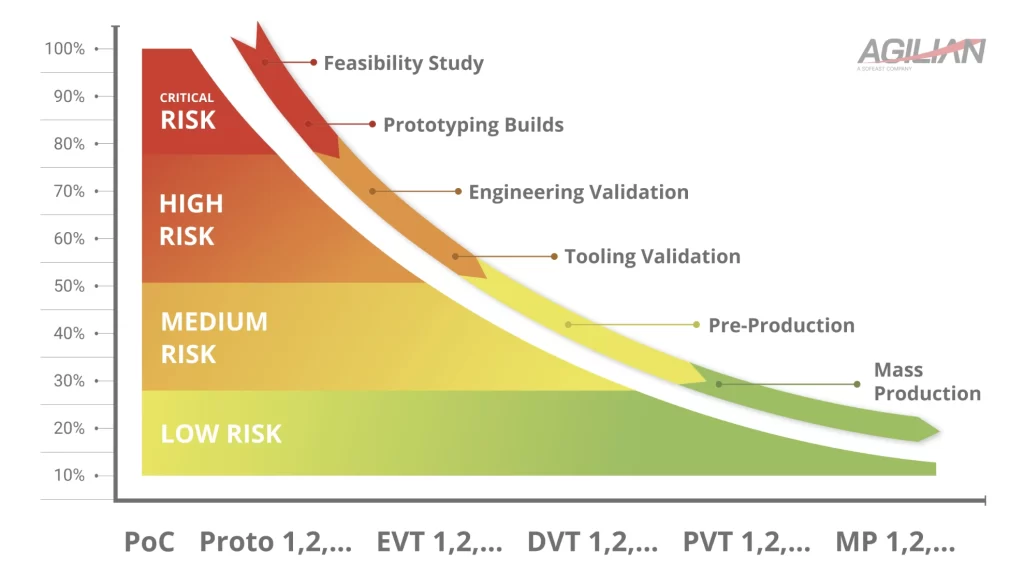
As you can see in this simplified graph, risks reduce as you progress through the product development stages towards mass production. Each stage represents a phase gate, and skipping any one of those gates (especially in the earlier phases) usually ends up costing a lot of time and money in 95%+ of cases:
Some people compare product development to a video game
Getting a working prototype is not the end of the hard part. It is more like clearing one level and unlocking the next one.
Each stage in hardware brings a new set of problems. A proof-of-concept answers one question. A functional prototype answers another. Tooling, testing, pilot production, quality control, fulfillment, customer support, and cash flow all introduce new risks that were not fully visible earlier.
That is where many founders make a dangerous assumption. They think that because the prototype works, scaling is the obvious next move. But prototyping and scaling are not the same game.
A prototype proves the product can exist. Scaling asks whether the whole business can support it repeatedly, reliably, and at the right cost.
As I sometimes say:
“You have designed the product, now you need to design the manufacturing & testing process and also the company operations, and fund all that”.
The better approach is to respect the level you are on. Start smaller, learn what the next stage demands, and build the systems needed before you move up.
6. Key Validation Steps in Product Design & Development
After some initial design work has been done and development progresses, there are now some key Validation Steps (or milestones).
- Functional prototypes achieving core requirements with positive user feedback
- Compliance pre-testing passed
- Reliability validation through accelerated life testing
- Final prototypes verified against all product requirements
- Design for Manufacturing (DFM) review for confirmation
- Product design can be frozen
7. Manufacturing Transfer
When transitioning to production, here are some good practices for reducing risk:
- Engage a suitable contract manufacturer with relevant experience and get them involved in DFM early
- Ideally, conduct a process FMEA (Failure Mode and Effects Analysis) exercise that involves the contract manufacturer
- Develop comprehensive manufacturing quality plans
- Evaluate tooling samples for aesthetic and functional issues
- Plan sufficient pre-production pilot runs (often called ‘PVT’) before high-volume production
8. End of Manufacturing Transfer: The Readiness Assessment
Do not let an over-enthusiastic manufacturer convince you that everything is ready. They make money on mass production, but you will need to deal with unhappy customers and their returns.
Before scaling production volumes up, you need to evaluate:
- First pass yield rates
- Manufacturing process stability
- Testing effectiveness and efficiency
- Outstanding engineering changes requiring resolution
9. Overall, what does the NPI process look like?
In electronics, most companies use the phrase “New Product Introduction” (NPI). It covers all the steps from the initial product concept definition until mass production.
You can watch a video about how we follow this process on this page. We cannot over-emphasize how important it is for your startup to follow a proven NPI process.
Do you need to go faster?
Many companies work with their contract manufacturer to find ways to compress the timelines between the product design freeze and mass production launch. Here is what it often ends up looking like:
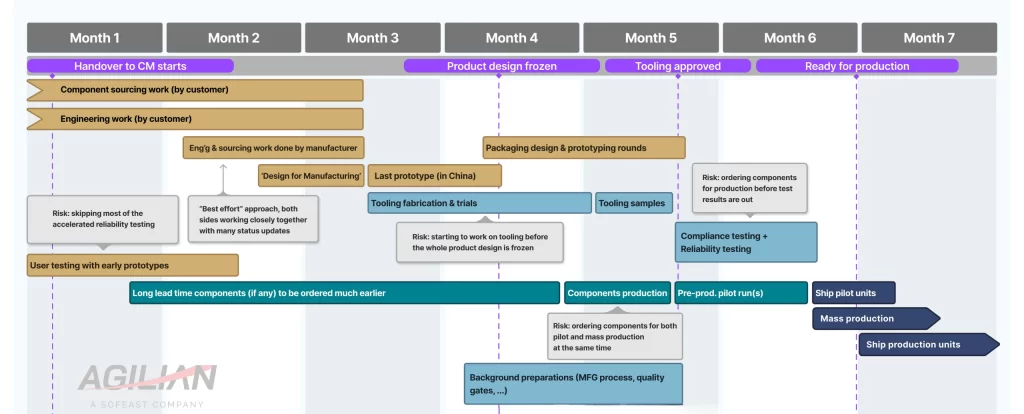
As you can see, many of these time compression decisions come with extra risk of running into issues… which means the likelihood of having to spend more money and more time goes up a lot. In other words, it is doable if it’s well planned & well executed by a well-experienced contract manufacturer, and you are lucky.
Ways to start delivering small quantities to market earlier
If you feel the need to start delivering finished products in the hundreds before investing in the development of the manufacturing process (including metal tooling fabrication etc.), you may need to use prototyping methods such as 3D printed molds.
We wrote about this in Do A Bridge Production Rather Than Rushing Into Mass Production. The unit cost is typically higher, but you get the product much earlier, and it can be a great way to get further feedback from the market. You still have a certain degree of design freedom at this point.
A variant of this may involve building a “version 0.9” that does the job, is not as well finished as production tooling would allow, but can be assembled in small quantities by your team internally. We wrote about the pros & cons of this approach in Starting Domestic Assembly then Moving Manufacturing to China (Pros & Cons).
Startup Killer 2: Takeaway
There are proven ways to systematically plan to reduce the risk of running into technical issues at each stage on the way to high-quantity production. Ignore them, and your chances of survival will be much slimmer.
While this approach requires more upfront planning and more careful execution, it dramatically reduces costly delays and quality issues that plague many hardware startups.
Startup Killer 3: Running out of Funding
Now, in this chapter, we’ll focus on how not to run out of cash.
For hardware startups that need to incur product design costs, upfront tooling investments, high minimum order quantities (MOQs) for some expensive components, and other cash outlays, a solid funding strategy is essential.
Developing a Solid Funding Strategy
A clear, well-thought-out funding plan should address the following:
- Self-funding – How much can you cover yourself in the early stages?
- Friends and family – Are there opportunities to secure early support from personal networks?
- Debt financing – Often a must for getting a hardware startup off the ground.
- Angel investors and venture capital – What level of funding will you need from professional investors?
- Crowdfunding – Could you raise funds this way? Keep in mind that it creates delivery obligations.
- Customer pre-payment – Is there a path to secure capital from early customer commitments?
- Customer terms – Will retail channels, or big customers in general, request payment terms? How many days after delivery?
- Invoice financing from a bank based on a customer’s purchase order – Will that be an option? Some customers’ banks even arrange it for suppliers.
- Margin per unit sold – Will you be making enough margin after the total landed cost and the marketing/distribution costs to scale the sales volume up?
When manufacturing in Asia, your funding plan also needs to cover the extra working capital involved in payment for production, way before the goods land in the country of sale.
You May Not Actually Need To Talk To Investors
If you can fund the initial phases of product development, sell company shares to friends & family, borrow money, and/or pre-sell the product to customers, you may not need external funding.
That typically requires a certain discipline. Here are three approaches that have enabled entrepreneurs to release a hardware product on the market without resorting to investors:
a) The stair-step method of bootstrapping
Former entrepreneur Rob Walling coined this term and applied it to software startups. The good news is, there is a way to do it in hardware, too, and this is an approach that we often suggest to hardware startup founders.
You can start by reselling an ODM product (which does not belong to you and over which you have limited control). Many Chinese companies accept selling their products as an ODM supplier. If you provide a good idea to improve one of their products, they often agree to bear the investment to make it happen and to grant you exclusivity over a certain market.
Here is the way it often plays out:
- Step 1: Resell an existing (ODM) product. Learn about the market. Establish a market channel. Learn what users tend to be frustrated about.
- Step 2: Work with the supplier of the ODM product to add 1 or 2 key features and negotiate exclusivity over your market. If you have purchased volumes that the supplier sees as significant to their own business, you can usually negotiate something special. You will probably need to pay for the extra development cost, maybe for a special mold, etc., and you may have to hit certain sales performance numbers, but it is often possible.
- Step 2b (sometimes makes sense): if step 2 is not possible for some reason, it may make sense to develop a product based on a pre-developed platform. This type of option is increasingly popular in Shenzhen. For example, finding the R&D company that has developed the PCB for a smart watch, finding a plastic supplier that already has a mold for the case of that smart watch, and then managing the development of the rest of the product around it. That’s cheaper and faster than step 3.
- Step 3: Once you have a clear idea of what a superior product would entail and what type of target users/customers it may be suitable for, invest in developing that new product from scratch with a contract manufacturer. Do things right, including contracts. Own the product. Register some intellectual property if that makes sense. It’s a huge step up from step 2, and it is more ambitious than step 2b, but it provides much more design freedom.
A down-to-earth way to scope Step 1
We found a helpful LinkedIn post (we link to that LinkedIn post so you can see the example and budgeting approach they outline) that shared a simple, no-nonsense way to answer “How much do you actually need to start?” Use it as a checklist to keep Step 1 small and survivable:
- Pre-launch essentials: samples & minor tweaks (not full tooling), basic packaging, a minimal photo/video set, and a lightweight landing/listing.
- First small batch: MOQ that you can sell through in weeks, not months; shipping & duties; basic compliance/marking where applicable.
- Go-to-market: one channel setup (listing + on-page SEO), one acquisition motion (e.g. marketplace search or a tiny paid test), and a tiny promo budget.
- Operating runway: 1–2 reorders worth of cash timing mapped against lead times; a contingency buffer so a slip doesn’t kill you.
- Pass/fail gates: “Greenlight only if” the contribution margin covers COGS + fees + minimal ad spend and shows a path to reorder without new capital.
The core message mirrors stair-stepping: constrain scope, make the math work at a micro scale, then reinvest.
b) Pre-sell the product
There are ways to collect money in advance from customers:
- If you sell to established companies that issue a purchase order (PO) to you, take advantage of the possibility of getting a bank’s financing against that PO.
- If you sell on a platform such as Indiegogo or Kickstarter, you collect funds for months, and maybe over a year, before you need to deliver products.
This can work well with differentiated products that address a pressing need. The more unique the product, and the more superior it is (for target users) over existing alternatives, the more certain customers will be willing to pay in advance.
We should also warn you about the unfortunate fact that most Kickstarter campaigns fail, either by not reaching their declared target, or by leading to costs (including setting up the campaign, paying advertising…) that surpass the margin it brings back. A consistent mistake we have seen is an insufficient margin on the price the product is offered on crowdfunding platforms.
c) Keep the product as simple as possible
This seems obvious, and yet many startups insist on developing what in their minds is a ‘perfect product’. You need to keep the product simple in 2 ways:
- Fewer features, focusing only on the few features that are most valuable to users/buyers, based on information gathered when doing ‘customer development’ work.
- Reusing standard off-the-shelf parts as much as possible. See the many custom components from this example of a product that went the opposite direction and is way too complex:
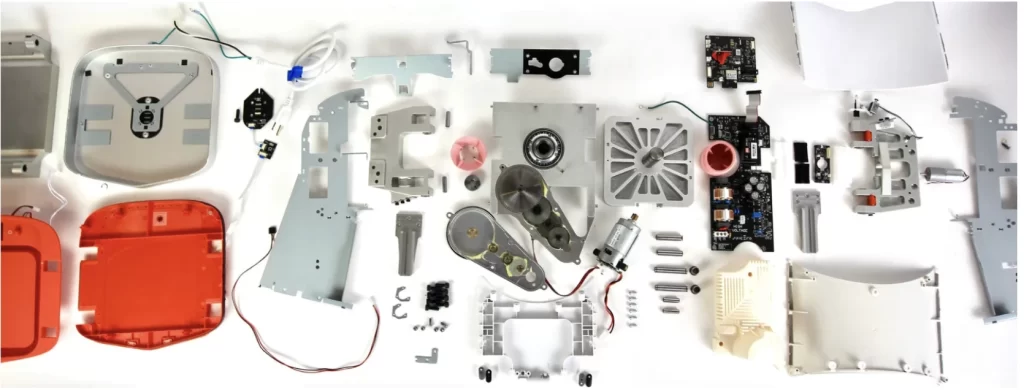
(Image from bolt blog, attributed above)
A simpler product comes with many benefits:
- Less design & development work, lower investment in tooling, and probably lower compliance testing fees.
- A shorter time to market, which means expenses in the pre-revenue phase are lower
- A cheaper bill of materials, meaning the product can be sold at a lower price point and/or the company can make more margin.
Now, if you still need to work with investors, we will provide general advice in the rest of this guide.
You may have to take on some debt
If you are in a startup hub, have good connections to potential investors, and are in an exciting space, you will probably try to raise money from investors. In other cases, if you need cash from other parties, the most likely source will be debt financing.
If you are starting your company from scratch, you will probably be asked to provide a personal guarantee, which can be stressful. Thousands of hardware entrepreneurs have done this.
It is not all about the downside. When the business goes well, leveraged works in your favor and you don’t give away control to investors. You have more options, such as bringing in investors later with less overall dilution of your shares.
Remember, once you have a “real company” that shows revenue and that has achieved at least break-even, there are ways to raise a loan. In the USA, many companies have been able to get an SBA loan.
Choose your Investors Wisely
You may want to Google “VC horror stories”. You will see how picking the wrong investors and giving them too much power can kill your company.
And, if you like to go to the bottom of a topic, you may enjoy the book “Venture Deals: Be Smarter Than Your Lawyer and Venture Capitalist” by Brad Feld and Jason Mendelson. This book will open your eyes to how exposed you will be if you deal with experienced investors without picking a suitable lawyer who defends your interests.
One more tip here. Make sure to work with investors whose experience is not solely in software products, as their expectations may not match the realities of hardware. They might push you to “hack something together” and “just fix it once issues appear”. However, if you skip the important validation steps we described earlier (remember the New Product Introduction approach?), your path to production will probably be quite painful.
What Investors Want to See
Let’s break the 3 main elements down:
1. Team Strength
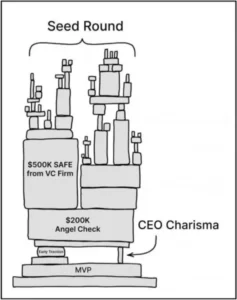
In the early days, the past experiences of the team and the ability of the CEO to sell a big vision are what matter most, as illustrated below. (Source.)
Here are important topics from the investors’ side:
- Do the founders have the right experience and talent? Have they successfully launched similar products before?
- Have they got a burning desire to ‘make it big’?
- Are they open to feedback or rigid in their approach?
- Do they understand the market and product category well?
- Does it seem that they know what to do, and they are getting good advice?
For a very early investment, all the attention is on the founders. Pre-seed and seed investors in San Francisco don’t need to see a working prototype. As Chrissy Meyer from Root Venture said, raising at this stage is “60% storytelling, 40% pedigree”, so a storytelling coach may be more helpful than a prototype.
2. Product Potential
In software, teams sometimes pivot and get to work on a completely different type of product. In hardware, the startup will probably live or die based on the product they are already designing.
Here are important considerations:
- Does the product align with current investment trends? (This is like fashion – certain product categories tend to be much more attractive to VC investors.)
- Are you talking to investors whose interests match your product category?
- Does the product spark excitement in initial discussions?
- Is the product sufficiently differentiated? For example, if you launch a health-related ring, how (and for whom) is it markedly different from an Oura ring?
- Is there a revenue stream that tends to be valued at higher multiples (e.g. recurring revenue for some software features, license revenue for access to proprietary data…) than hardware sales?
3. Market Size
If the market is non-existent or is small, a company will have difficulty growing to what professional investors aim for (at least a 100 million USD company).
Here are typical questions they ask:
- Is the market large enough to attract serious investor interest?
- Is there strong evidence of long-term growth potential?
- Has the founding team carried out some important market discovery work? (See the earlier article about getting the market right.)
- Is there evidence of market traction?
You need to be ready to present those 3 elements of your startup in a positive light if you want a chance at getting investors interested. Venture capitalist Jeff Clavier sums it up as his “three asses” rule: he’s looking for “a smart-ass team building a kick-ass product in a big-ass market”.
What Investors Don’t Like to See
Many investors detect risk when they see certain ‘amber flags’, and they tend to give excessive weight to those signals. Here are a few typical examples:
- “Inactive founders who still hold many shares” – many startups end up with a bad capitalization table early on because of inactive founders who were given shares without the usual provisions of a good shareholder agreement.
- “A lot of debt” or “poor reputation”. Some hardware startups have managed to acquire both because of a crowdfunding campaign that was done at a price that is too low to pay for the factory price of making the product. The company delays the launch, starts to sell in other channels to get some margin and stay alive, gets bad press, and still owes all those products to the backers – it is effectively a debt!
- “Manufacturing will be in China” – that has become scarier and scarier to USA-based investors. Does it make sense in the long term? Time will tell.
- “This seems easy for Chinese factories to copy” – that is a real concern for certain types of products. See two examples we saw first-hand in ‘How Chinese Knockoffs Are Killing Innovative Hardware Startups.‘ The right approach is usually to avoid creating a lot of buzz on the internet and to sell the product in channels where sales numbers cannot be estimated, as an effort to avoid attracting attention in China. On the other hand, certain products are very challenging to manufacture and cannot really be simplified, and they are in a better position; see this amazing keyboard, for instance.
Building a Credible Business Plan
A well-prepared business plan should detail your capital needs from design to production scale-up. Include key non-recurring engineering (NRE) costs like:
- Design fees, prototype materials, and testing
- Mold Tooling costs – Fabrication, adjustments, and setup
- Compliance and reliability testing costs
- Travel expenses – Factory visits, supply chain meetings
You should also plan for your unit economics – estimated factory cost, landed cost, and target margins.
Many hardware startups find out way too late that their COGS (Costs Of Goods Sold) are too high and will force them to sell the product at a higher price, leading to a lengthy redesign. Some actually go to production anyway because of the pressure of deadlines, but they don’t have the margin for marketing & distribution or for scaling up. (See “Startup Killer 1 – Market Misjudgment & Mispreparation” earlier, where we discuss the importance of knowing what features are critical and which ones can be dropped if necessary.)
A clear business plan gives investors the ability to check & confirm that you’ve accounted for realistic costs of hardware development as well as marketing & distribution.
Providing sufficient runway to iterate into a new product concept in case the initial plan does not succeed is often advised. This needs to be paired with compressed development cycles. If you iterate fast, you can probably have more than one shot at success!
Managing Funding Execution Risk
Marc Andreessen warns that poor execution of a financing strategy sinks many startups and stresses the need for prudent financial strategies and disciplined execution in this series of tweets. In his eBook: The Pmarca Guide to Startups: Part 2, When the VCs Say No, he says that hardware startups that have already received knockbacks from VCs should also:
“Rethink very carefully how much money you will need to raise after this round of financing and try to change the plan in plausible ways to require less money.”
Being financially prudent and organized is especially true for a new hardware product:
- Set realistic fundraising timelines – Expect delays in investor decisions.
- Raise more than you think you need – Hardware development almost always costs more and takes longer than expected.
- Start early – Begin raising the next round while you still have at least six months of runway.
- Have a backup plan – If your primary strategy falls through, know where to turn next.
- Watch the market – Broader economic conditions can affect investor appetite.
Be specific about your production ramp-up plan. Common mistakes include:
- Rushing pre-production validation, leading to quality problems
- Planning to scale production up faster than available cash flow will allow
Since manufacturers rarely offer credit terms to startups, be prepared to cover deposits and balances on time.
Strategic Funding Milestones
A staged funding approach helps align capital with development progress. It often looks this way:
- Self-fund until you have a functional prototype (it doesn’t need to look perfect yet). If you don’t have a prototype yet, most investors will turn you away.
- Secure engineering prototype funding once you’ve demonstrated both form and function.
- Raise production funding after you’ve validated tooling and production processes. (Only do this if you couldn’t raise enough in step 2 to also get you through step 3… ideally, you could raise enough).
The ideal situation is to raise enough capital to cover product development, manufacturing transfer, and initial production ramp-up until unit margins can support ongoing production. This is confirmed by three young entrepreneurs interviewed by Forbes, one of whom actually warns against raising too much funding:
“When designing the amount of money you want to raise, try to think 18 months or 2 years,” he said. “More, and it will explode your financial bladder, and you will use the money too fast.”
This bears repeating. If you raise money during or at the end of product development, raise more than you think you will need. In most cases, startups underestimate the likelihood and the impact of unpleasant surprises. Being stuck at the phase where the company has done all the work to be ready to go into production, but has no cash for it, is very uncomfortable. There is no momentum to get investors excited. For founders, this is extremely frustrating.
A couple of common funding pitfalls we have seen too often
- The startup does not raise enough money to go all the way from prototype to mass production (including the production and marketing/selling costs), and then they find that all investors ask for evidence of fast & easy sales before they fund production.
- The startup needs an amount that is too large for most angels but too low for a traditional VC firm, and that makes raising money much more complicated than it should be.
Accounting for Delays (Because They Will Happen)
Hardware development rarely goes perfectly, especially when manufacturing overseas. Build financial buffers for:
- Certification delays
- Tooling revisions
- Supplier issues
- Component failures
- Testing and validation bottlenecks
Startup Killer 3: Takeaway
By carefully planning your funding strategy, setting realistic timelines, and preparing for the challenges of hardware manufacturing in Asia, you’ll create a more resilient foundation for your startup. Underfunding usually means the company fails, sometimes after years of hard work.
How Agilian Helps Hardware Startups Move from Idea to Production
Avoiding the three major hardware startup killers requires more than a good idea, a prototype, or a factory that says it can make the product.
Hardware startups need a structured process to reduce risk step by step: prove the concept, validate the design, prepare for manufacturing, test the production process, and scale only when the product is ready.
Agilian supports adequately funded hardware startups that have some evidence of market traction through this New Product Introduction process. We work only from the early ‘feasibility’ phase with a few companies at any time, but we typically work through the later validations and pilot builds (and into mass production) with a few dozen customers.
Our NPI Process: A Structured Path from Concept to Production
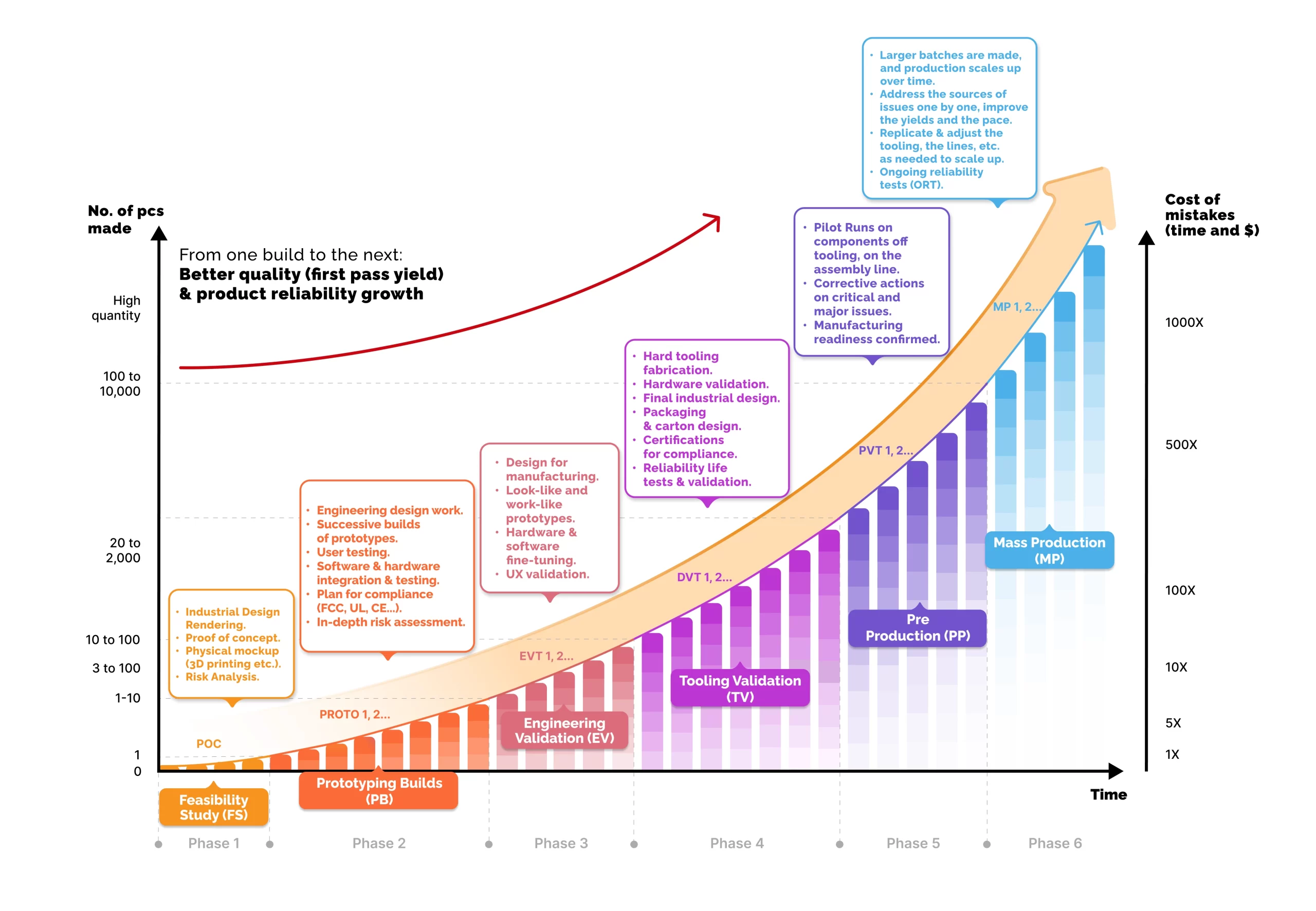
This process is divided into six phases:
- Feasibility Study / Proof of Concept
The aim is to check whether the product can be made and whether it can perform as intended. This may include reviewing the Product Requirements Document, refining the concept, selecting key components, estimating costs and lead times, and building an early proof-of-concept prototype. - Prototyping Builds
The product is developed through plan-design-prototype-test cycles. Mechanical, electronic, firmware, and other engineering work is carried out as needed. The goal is to move from concept toward functional prototypes while checking manufacturability, reliability, and key requirements. - Engineering Validation
This phase usually covers the final iterations before design freeze. EVT prototypes are built and tested, issues are addressed, and a Design for Manufacturing review helps confirm that the product is suitable for production. This is often the time to hand over the work to a contract manufacturer like Agilian. - Tooling Validation
Tooling, molds, fixtures, and related production equipment are designed and tested. DVT prototypes are assembled and checked, golden samples may be selected, and reliability, compliance, and certification work can be arranged where needed. - Pre-Production
Pilot runs are used to test the manufacturing and assembly process before larger production quantities are made. This helps identify issues with fixtures, jigs, testing, assembly steps, operator training, and quality controls while volumes are still low. - Mass Production
Once the product and process are ready, production can begin. Agilian manages material purchasing, incoming QC, in-house manufacturing where applicable, assembly, testing, packing, outgoing QC, reporting, shipment, and ongoing improvement.
Why This Matters
This phased approach helps hardware startups avoid committing too much too early.
Each stage gives the team more information before moving to the next investment decision. It also helps control technical risk, avoid premature tooling, validate the manufacturing process, and reduce the chance of costly production surprises.
For startups and companies new to launching hardware, the goal is not simply to build a prototype. The goal is to reach a product that is manufacturable, testable, reliable, and ready for customers.
Agilian’s role is to help companies move through that journey with more structure, clearer decisions, and better control over cost, quality, timing, and risk.